by Astrid Scholte
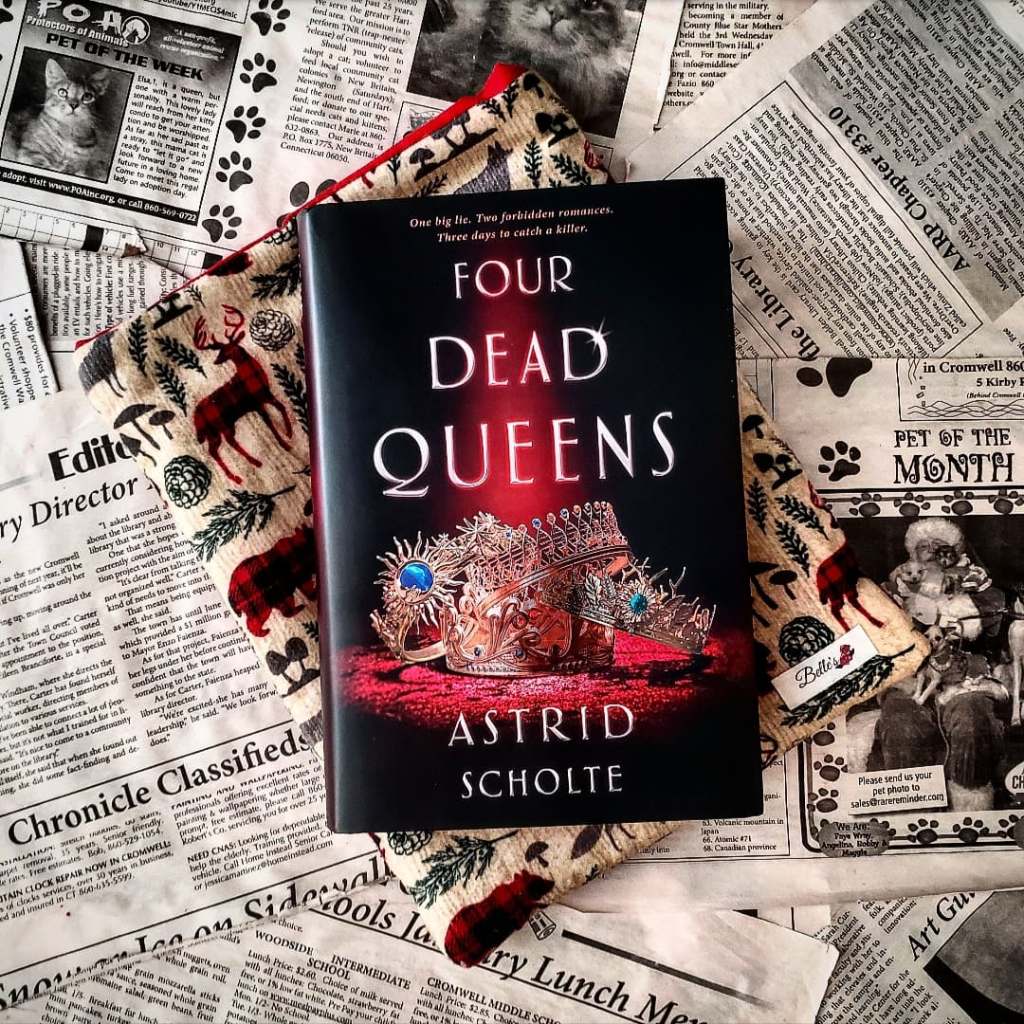
This is a book that I’ve had on my TBR and shelf for ages and just never got around to. I’ve wanted to multiple times, but other books came up with urgency or I wasn’t feeling a fantasy murder mystery, etc. – but I finally got to it!
This was a fun who-dun-it, as some people put it, and I enjoyed it rather a lot. It made me put The Vanishing Deep on my Book Wishlist in my Owlcrate Reading Planner for March. I’m hoping it’s as good as Four Dead Queens was for me!
Alright, so, onto the book contents and characters, shall we?
Keralie is a wonderfully complicated, deep character. She has a past, a history, that not only feels as if it could be real, but lends a lot to her character arc and helps build a believable, complicated person. That history is revealed at a pace that, while maybe a touch too drawn out, is well paced. It’s not all at once, nor is it only revealed when it’s perfectly convenient to the story – it comes about the way it would for any person, sparked by the events around them, and not always at a perfectly timed moment. While sometimes Keralie got on my nerves, she got on my nerves in a way that I feel lends credibility to her – she annoyed me by her realism, thought different to how I would have handled things myself, which is exactly how it should be. Keralie is a different person to me, so it’s not surprising that she handled things differently, even if that different way annoyed me. If she had been more similar to me and handled things in a way that was out-of-character but convenient to the plot, it would be a different sort of annoyance, and wouldn’t have lent so much to a believable character.
Varin is also a wonderfully complicated character. While his character arc is a little more cliché, it was no less well done. You felt for Varin by the end, which is something his Eonian roots would balk at. There will be more about his character arc after the spoilers “line”, he starts off more-or-less exactly how you’re anticipating an Eonian messenger to behave, though even that is set up to be an interesting compliment to how Keralie starts off. I won’t go into too much else at the moment to not give too much of the book content and enjoyment away!
His character arc, while complimenting Keralie’s, also had a enough inconvenience to it to be realistic. It’s rare that two people’s development “arcs” compliment each other perfectly. While their character arcs caused conflicts at moments, it didn’t feel forced, even though it perfectly helped the plot development. While it could cause the reader to be upset or distressed, it was not done poorly or unrealistically. It’s actually how well done it is that leads to the reader’s upset or distressed reaction.
I’m finding it difficult to avoid spoilers, so I’ll dive into them after I give my recommendation: if you like murder-mysteries and fantasy, or at least don’t mind it being set in a fictional world, I recommend this book. It’s been awhile since I’ve read a mystery, but I’ve read mysteries that were far easier to guess the ending of than this one. While maybe not the best mystery book I’ve ever come across, it’s definitely far from the worst.
**SPOILERS BEYOND THIS POINT. DON’T READ FURTHER IF YOU DON’T WANT SPOILERS. I STRUGGLED WITH NO SPOILERS ABOVE, BUT I WILL SHOW NO SUCH RESTRAINT GOING FORWARD. YOU’VE BEEN WARNED.**
ALRIGHT. Now I can dive a little more into details.
The author leads you to believe, at a certain point, that Keralie is Queen Marguerite’s “long lost” daughter. That she will inherit the country, in it’s entirety. So then it becomes even more twisted when you discover that not only is Keralie not the heir, but that the heir shares Keralie’s original love interest! That’s also an interesting dynamic – Mackiel’s and Keralie’s, and, later, Mackiel’s and Arebella’s.
While, once Arebella came into the picture, it did start to feel a little more cliché than I would have liked, the twist of Keralie being the murderer was fun. While it was hinted at and didn’t come as a complete shock, it did come as a complete shock that Keralie ended up playing into Mackiel’s plans for her one her own rather than at his hand, by his plan exactly.
Arebella, though, was obnoxious. And I understand that she is meant to be that way, but goodness. What a spoiled brat. Textbook definition of the “I was denied my birthright, the world owes me everything, more than I originally was due, etc.” – but it was crucial to the plot, to setting up a satisfying ending, to make you wish for Arebella not to rule, for Marguerite to take her throne back and find some other way for the kingdom to continue on.
I do kind of want to see Keralie’s and Varin’s lives continue on, to see that relationship develop further. While the romance there wasn’t necessary at all, it did lend to both of their character arcs. It wasn’t forced, but it wasn’t as smooth as other book romances.
Speaking of Varin’s character arc, though, I’m so glad that, even though to non-emotional-turned-emotional trope is a little over done, I think his twist of wanting to be an artist/painter that was slowly losing his sight was a fun twist to that trope.
Keralie. I don’t know if she deserved the super rare HIDRA treatment. Not when there were probably other people more deserving of the treatment. I don’t know what would have been a satisfactory ending for Keralie and her family, but I wasn’t sure she had earned that level of reward by the end. Sure, she had been through a lot, been manipulated by a childhood friend and Marguerite’s daughter and heir, been arrested for a crime she didn’t mean to commit, etc., that doesn’t exactly mean she deserves the rarest reward in the kingdom.
Anyway – I very much enjoyed the book, overall, even keeping in mind the flaws and shortfalls. Once again, I’m not disappointed by an Owlcrate book.
My next read is Clockwork Angel, but I haven’t yet written my review of Ruthless Gods from last year, so that may be the next posted review!
 The Fox Den