DISCLAIMER: First, this deep dive, unlike my book reviews, is subject to change/updates as new information becomes available. Second, and I will mention this again later, but I want to put this upfront, in case you never get to where this, contextually, comes up: I am in no way accepting, or not accepting, apologies made by Jay Kristoff. It is not my place. The goal of this is to present the information I found when his problematic accusations came to light back in April to help others make their own educated decision. My personal opinion can be found near the end of this post, but I am purely reacting to the information presented to me the only way I can – as someone who isn’t in one of the communities impacted, but who strongly believes in accountability rather than blind cancel culture. I did this for my own “homework” to make an educated decision rather than a blind, bandwagon one. Please also understand that I am in no way trying to minimize the hurt felt by anyone by boiling things down to facts.
Before starting this post, I want to be clear: I am not a journalist, I am not an expert, nor should any of my work here be considered as anything close to that. I am simply a reader, and book review writer, who decided I wanted to learn more and look more into authors that have been brought to my attention as problematic, which turned into a deeper look at “cancel culture” in general, which can be found here. I will be covering other information and answers to questions I’m anticipating you, my reader, might have nearer the end of this. Of course, I am always open to questions not addressed here, as well as try to expand on any answer I provide that you may find lacking. I’m always open to [respectful] communication. I just ask that you be that – respectful. Also, apologies for the length of this, but, I promise, it’s long because of the amount of content, and I feel all of it deserves to be showcased and shared.
**THIS POST NOW CONTAINS SPOILERS FOR THE NEVERNIGHT CHRONICLES – READ THE NEVERNIGHT CHRONICLES SECTION WITH CAUTION. THE SPOILERS ARE CONTAINED IN THE PARAGRAPHS AFTER THE GOODREADS SCRUB.**
I haven’t made my love of The Nevernight Chronicles a secret, nor have I shut up about The Illuminae Files to anyone who lets it come up in conversation [doesn’t even have to be a conversation about books, honestly].
That said, I also heard the problematic things that have been brought up by many.
From what I understand, this is all coming up [some of this is a repeat, some of it is new] because he has 5 different ARCs for his newest book, Empire of the Vampire. The controversy here is that Jay Kristoff, a white, male author, has 5 types of ARCs being circulated while many BIPOC authors don’t have any.
So, I decided to do a deep dive, to take my time collecting facts and opinions from what information was available to gather. I’m going to dive into Goodreads reviews and anywhere I can to gather proof of if and/or when problematic things were brought to light. I’m going to break down this information by series, where possible.
I should also note that I’m only working on his novels because two of this other pieces, including in Story Behind the Book: Volume 3 and Slasher Girls & Monster Boys [this piece is also included in The Year’s Best Australian Fantasy and Horror 2015], don’t seem to have much by way of reviews. I also won’t be doing a deep dive on his non-problematic books, as that doesn’t really serve the purpose of scrubbing problematic content, though I will include a full list of his works.
Every Goodreads Review Scrub will include a link in the scrub title. Feel free to check any and all of this information for yourself. For the number of POC reviews, I’m only able to identify them from the information readily available to me. If they don’t have some sort of identifier in their profile that marks them as one, I can’t identify them as one. When I include this data, I’ll list them as POC / Unknown Reviews. [Ex: 15 / 6 – 15 confirmed, 6 unknown.] Please keep in mind: 1) if any review states or implies it’s actually updated post-publication [post-pub] and further diving implies, or, better yet, confirms that belief, I will remove that data entry entirely, and 2) that I’m human and make mistakes. This is my honest attempt to compile this information to inform curious minds, not to twist data.
I’m trying to put together a source of information for anyone looking to do their own research. The point in this post isn’t to clear or damn him, but rather to gather information so that you, the reader, can make up your own mind. Where possible, I will attempt to keep my own voice and opinion out of it. This is about information and fact-finding, not about opinions and feelings. Any comment I feel is more driven by opinion than fact [whether that be because it’s information I’ve found “by word of mouth” or my own conclusion drawn from the publishing world information I know], I’ll put them in white. Take these comments with a grain of salt.
That said, I will include my thoughts and reactions to the facts I’ve uncovered. This section will be completely optional to read, and please understand that I’m not an expert in this. I’m just another reader trying to do right by both readers and authors. If what I find leads me to the conclusion that Jay Kristoff is, indeed, problematic, I won’t be supporting him and his work anymore.
Current list of novels by Jay Kristoff:
~ The Lotus Wars [Stormdancer, Kinslayer, and Endsinger]
~ The Illuminae Files [Illuminae, Gemina, and Obsidio]
~ The Nevernight Chronicles [Nevernight, Godsgrave, and Drkdawn]
~ LIFEL1K3 [ LIFEL1K3, DEV1AT3, and TRUEL1F3]
~ The Aurora Cycle [Aurora Rising, Aurora Burning, and Aurora’s End {coming Nov 2021}]
~ Empire of the Vampire [Empire of the Vampire {coming Sep 2021}, #2 and #3 TBA]
The Lotus Wars
This series is the one that has been brought up before, is being brought up again, and has been brought up the most over time. Here are some facts about this series, just to start off:
~ Stormdancer is Jay Kristoff’s debut novel.
~ On Goodreads, all the starred reviews up until publication [854 starred reviews, removing none] average around a 3.9. All things considered, that’s not a half bad rating for a pre-publication debut novel. Not great, but not bad.
~ One review, dated July 9th, 2012, marks the “current average” as 4.41. Please note that my attempted average is skewed towards a lower average because I wasn’t able to get to all of the pre-pub dated reviews in the 4 and 5 star range. A lot of reviewers were told to wait until August 1st to post their reviews, and not many got to be represented in this scrub [written, anyway]. 4 Star reviews got cut off on August 17th and 5 stars got cut off on August 9th while lower star ratings were lower numbered and therefore I was able to represent them all. This skews the average I was able to calculate negatively, likely meaning the 4.41 is more accurate than my own.
~ There are Japanese versions of this book. Two manga/anime style books per English novel of book 1 and 2, from what I can tell.
Now, this is information that I’ve gleaned here and there and have no proof to post here. This content was not found anywhere, but it isn’t really a personal opinion. Regardless, because it isn’t found fact, I’m marking it white. Remember that this section isn’t fact and should be remembered that it may be incorrect. “Not found” information:
~ I haven’t “found” it yet, but I have been following Jay Kristoff on social media since around 2019 and haven’t ever seen him once “advertising” or “promoting” The Lotus Wars, not the way he continues to advertise and promote The Nevernight Chronicles and The Illuminae Files, now that both series have been concluded.
~ I can’t find this, but I heard he’s told book box companies not to include items inspired by The Lotus War trilogy. This furthers the idea that he’s not trying to promote these books anymore because he’s been told they’re problematic, and that tells me he’s trying to do his best to make amends because it was unintentional.
~ If memory serves, he doesn’t talk very highly on his own about this series, without the problematic parts being brought up.
The only complaint “cancel culture” has accused this series of that I’ve found is Asian cultural appropriation.
Stormdancer Goodreads Review Scrub:
~ 1 Star Review Recap
Number of reviews: 36*
Number of Asian reviews: 3 / 5
Number of Asian reviewers that complained about cultural content: 2 [66.6666%]
Number of 1.5 star reviews: 4
“Weighted” average: 1.04
* = Two of these reviews were edited later [one 8 years later], so it’s possible these star review numbers were changed and weren’t originally 1 Star Reviews.
I tried to take note of what the reviews commented negatively on the most. I tracked general content, writing style, cultural content, and the main character, as most complaints fell into those categories. The top complaint was the writing style, followed by the general content, a close third being cultural content, and, finally, the main character.
~ 2 Star Review Recap
Number of reviews: 49*
Number of Asian reviews: 6 / 2
Number of Asian reviewers that complained about cultural content: 2 [33.3333%]
Number of 2.5 Star Reviews: 2
Number of 2.75 Star Reviews: 1 [This rating came from a 5.5 rating on their blog and was an Asian reviewer.]
“Weighted” average: 2.04
* = Four of these reviews were edited later, so it’s possible these star review numbers were changed and weren’t originally 2 Star Reviews.
The top complaint was the general content, followed closely by cultural content, then writing style, and, finally, the main character.
~ 3 Star Review Recap
Number of reviews: 152*
Number of Asian reviews: 15 / 6
Number of Asian reviewers that complained about cultural content: 4 [26.6667%]
Number of 3.5 star reviews: 8
Number of 3.25 star reviews: 2
Number of 3.75 star reviews: 1
“Weighted” average: 3.003 [ended at the first decimal that doesn’t round up]
* = Eleven of these reviews were edited later, so it’s possible these star review numbers were changed and weren’t originally 3 Star Reviews.
The top complaint was the writing style, a distant second goes to the general content, then cultural content, and, finally, the main character.
~ 4 Star Review Recap
Number of reviews: 272*
Number of Asian reviews: 18 / 26
Number of Asian reviewers that complained about cultural content: 0 [0%]
Number of 3.5 star reviews: 4
Number of 3.75 star reviews: 1
Number of 4.25 star reviews: 1
Number of 4.5 star reviews: 13
* = Twenty-nine of these reviews were edited later, so it’s possible these star review numbers were changed and weren’t originally 4 Star Reviews.
“Weighted” average: 4.0165 [ended at the first decimal that doesn’t round up]
The top complaint was general content, followed closely be a tie of writing style and cultural content, and, finally, the main character.
~ 5 Star Review Recap
Number of reviews: 256*
Number of Asian Reviews: 26 / 24
Number of Asian reviewers that complained about cultural content: 2 [7.6923%]
Number of 4.5 Star Reviews: 2
* = Forty-four of these reviews were edited later, so it’s possible these star review numbers were changed and weren’t originally 5 Star Reviews.
“Weighted” average: 4.996
The top complaint was writing style, distantly followed by general content, then cultural content, and, finally, no complaints about the main character.
It’s also worth noting that the two 4.5 star reviews had complaints of the info-dumping in the beginning and, “the complexity of Yukiko’s relationship with the green-eyed samurai.” Neither complained of cultural content – one reviewer was Asian, the other considered an unknown. All the cultural content complaints, including the ones by Asian reviewers, didn’t lower the perfect 5 star rating while doing so.
Visual representation of where Asian reviewer voices were divided among the stars:

Visual representation of cultural content complaints amongst Asian reviewers:
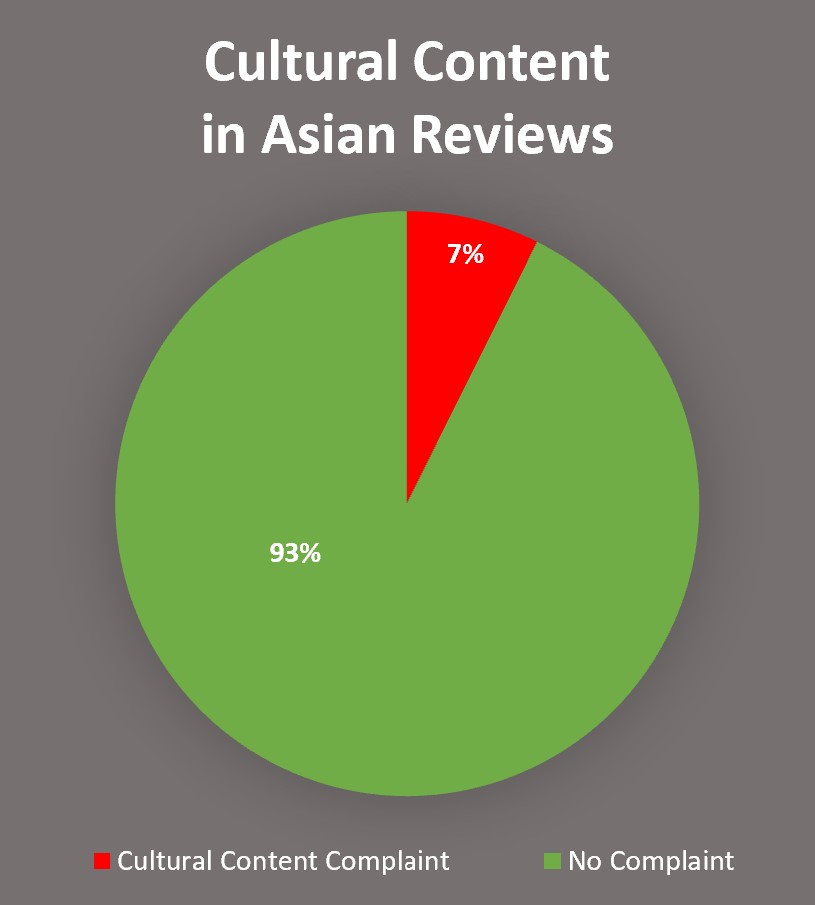
The amount of Asian reviewers complaining of cultural content problems is shockingly low for the claims of the Asian community not approving. Only 7% of Asian reviewers consider the books problematic. That’s 68 reviewers total, for those that want the final math on that. I wanted to add a visual representation of the Asian voice, but I honestly expected the pie charts to look different than they do.
While I scrubbed Kinslayer reviews, I ultimately found only one negative pre-pub review, and even that review admitted that, while they believed there were still issues, the cultural content had improved.
I’ve seen it mentioned a few times that he gave a problematic answer to an interview question about his research for The Lotus War, but I’m struggling to find that source. [I’m looking for the source rather than just the screenshot I’ve seen floating around because I can’t verify the source of it, which means I can’t authenticate it.] I’d also like to add that I’ve been told he has apologized for this series in the past, but I have been unable to confirm or deny that. If anyone has a link to this apology, please let me know, and I’ll update this with it! In a live Obsidian Moon Crate did the other day, they mentioned that when they asked to do The Lotus War items, they made it clear the answer was no. Feel free to watch that live to hear for yourself. In that same live, they mentioned Jay Kristoff had apologized for The Lotus Wars. I also want to add that there was a review linked a few times in the reviews I read, but the link led me to a site that required the owner to grant me access. After multiple attempts to be granted access, I was not, so I was unable to access that referenced source of information.
The Nevernight Chronicles
This is the newest problematic series for Jay Kristoff. As before, these are the facts about the book I’ve been able to glean:
~ The Nevernight Chronicles is Jay Kristoff’s second adult series.
~ Nevernight had 10 physical ARCs that Jay Kristoff brought with him, “in a broken cardboard box” to BEA 2016: Book Expo [in Chicago that year].
~ The Nevernight 5 star rating cuts off June 9th, 2016 – before pre-pub cut-off, meaning my calculated average will be off, though I don’t know by how much.
Now, this is information that I’ve gleaned here and there and have no proof to post here. This content was not found anywhere, but it isn’t really a personal opinion. Regardless, because it isn’t found fact, I’m marking it white. Remember that this section isn’t fact and should be remembered that it may be incorrect. I’m also including relevant Empire of the Vampire information, since no dive is being done on that book in this post. “Not found” information:
~ This is the first solo series where you can see that he’s establishing his “I do something different every time” mentality with his writing.
~ While people have “accused” him of sticking to “older” teenage girls as MCs, his latest book is a change from this – an adult male MC who has flashbacks to his younger, teenage days as he tells his life story.
Complaints listed against this series:
~ The Māori people are being culturally appropriated through the character Tric
~ Young girls are being overly sexualized
~ Incorrect/harmful representation of albinism
~ Possible antisemitic content
Nevernight Goodreads Review Scrub:
~ 1 Star Review Recap
Number of reviews: 51
Number of Jewish reviews: 0 / 1
Number of Maori reviews: 0 / 0
Number of Jewish reviewers that complained about antisemitic content: 0
Number of possibly Jewish reviewers that complained about antisemitic content: 0
Number of Maori reviewers that complained about Maori cultural content: 0
Number of possibly Maori reviewers that complained about Maori cultural content: 0
Number of 1.5 star reviews: 0
“Weighted” average: 1.00
One of these reviews was edited later to include Maori cultural appropriation, but it’s self-admitted to not be self-caught, so it’s likely the rating wasn’t altered, so the data point remains, minus the cultural content complaint.
That said, there were zero accusations of either Maori cultural complaints nor antisemitic content complaints.
~ 2 Star Review Recap
Number of reviews: 37*
Number of Jewish reviews: 0 / 2
Number of Maori reviews: 0 / 2
Number of Jewish reviewers that complained about antisemitic content: 0
Number of possibly Jewish reviewers that complained about antisemitic content: 0
Number of Maori reviewers that complained about Maori cultural content: 0
Number of possibly Maori reviewers that complained about Maori cultural content: 0
Number of 2.5 star reviews: 1
Number of 1.5 star reviews: 1
“Weighted” average: 2.00
* = One of these reviews was erased, so the data was removed.
The only review I marked as complaining of cultural content was more that a reviewer was uncomfortable with a white man making a racial slur [unique to his fictionally self-made race]. Otherwise, no antisemitic or Maori cultural content complaints were made.
~ 3 Star Review Recap
Number of reviews:
Number of Jewish reviews: /
Number of Maori reviews: /
Number of Jewish reviewers that complained about antisemitic content:
Number of possibly Jewish reviewers that complained about antisemitic content:
Number of Maori reviewers that complained about Maori cultural content:
Number of possibly Maori reviewers that complained about Maori cultural content:
Number of 3.5 star reviews: 5
Number of 2.5 star reviews: 1
“Weighted” average: TBD
* = One of these reviews only has a pre-pub excitement comment, no post-read review content, so the data was removed.
The biggest complaint across all the reviews thus far have overwhelmingly been general content [like the footnotes or how unoriginal the idea is] and writing style [his prose].
I have begun, but currently not finished the 3, 4, or 5 star review scrub. While I can technically “search” through the reviews in Goodreads for buzz words, this time I’m finding the results inconclusive and unreliable. So, while the search results are yielding no pre-pub problematic reviews of antisemitic or Maori cultural appropriation content, I can’t in good faith give you a confirmed number of that.
For the antisemitic content, I wanted to state a few facts and anything I can remember about the book contents from my read throughs, though I wanted to add that it has been a little while since I’ve read them, and my memory might not be amazing:
~ Majority of the blood used in the blood magic of the series was pig’s blood, not human blood
~ The blood sorcerer’s sister’s name “Marielle” and is a name of French/Dutch origin, not Jewish or Hebrew, unlike his
~ Jay Kristoff stated that the blood in the Red Church pools [majority of the blood magic uses these pools] is pig’s blood, not human blood, through this footnote in Godsgrave:
1. Two thousand-odd cubic feet of vitus fills every Chruch blood pool.
2. There are approximately seven and a half gallons of liquid per cubic foot.
3. The average pig holds approximately one fallon of blood in its body.
Do the math, gentlefriends. And ask yourself if you ever want to be filling one of these damn pools twice.
~ A portion of the basis for the blood libel accusations is connected to the original name used, which Jay Kristoff has since changed to Marius
~ At one point in the series, Mia spoke to him about his magic and blood craving/consumption, and he told her it hadn’t always been like that – that his and his sister’s magic had been cursed. In the final book, through Mia’s [the MC’s] actions, the “curse” is reversed, and the magic is returned to “normal” with proof through Marielle being capable of reverting her appearance to rival her brother’s in perfection
To prevent any further offense, the character he is under fire for will be referred to here as “The Sorcerer”. I know he has a new name, but not everyone connects Marius to this character yet, but they do connect him with his identity as a sorcerii. Here is what I can remember about The Sorcerer:
~ He doesn’t drink the pig’s blood used in the pools
~ [This portion is dependent on my memory, so I’m marking it white until I can confirm] There comes a moment in the series where it’s proposed to The Sorcerer [I think his life was dependent on it?] to use the pool he lives nearest, but he responds in disgust and refuses [possibly even stated he’d rather die that touch the blood, but I’m not 100%]
There’s more to come on the antisemitic research, but I wanted to add these notes that I had thought to add before, but neglected to.
While I have begun my Maori research, the only progress I’ve been able to find has so far proved unsatisfactory to me, so I want to dig deeper before stating the little I’ve found!
I do plan to patch as many holes/WIP portions of this deep dive in the future, so keep your eyes open for that!
Anticipated Questions
[These will all be a combination of facts and opinion, as I’m answering these with nothing but my interpretation and views of the research above. I won’t be putting these answers, in part or in full, in white. Instead, I’m putting this disclosure in white, and please keep it in mind going forward.]
Why is this so much different from your report on Emily A. Duncan?
So, this is largely why I’m calling the post on them a report and this one a deep dive. There’s so much more here, so it felt wrong to call them the same thing. Their history, and number of problematic books, is less, and because there was less out there on their problematic content, there’s less in their post. Because so many accusations were made against him, there’s more research, and more that felt relevant to present here. Also, a good chunk of the outside-of-books content against them was on Twitter, and therefore that post had more pictures, where as the research here was more data, so there’s more typing and pie charts to visually show that data.
Goodreads has been accused of censoring reviews. How is that represented here?
There’s definitely that possibility, and I’m not knowledgeable enough on that specific topic to speak much to it. However – the first review I see when I go to the Stormdancer Goodreads page – above even Jay Kristoff’s review! – is a long, scathing, 1-star review of the book. The 5th review down is a scathing, own voices review where she rips into the book without restraint. Of the first “page” of reviews, there are several Asian reviewers. While this doesn’t mean there isn’t censoring going on, if I was going to censor reviews, those first two I mentioned would have been not only removed from the first page of review results shown when visiting the page, but removed entirely, no filtering required. Before you add, “Yeah, but, they can’t remove all of them, or we’d know they were censoring”, there are enough other own voice reviews that could have been left to “fake” making it look uncensored, and they didn’t. It just doesn’t make sense to have left the ones they did when there were “better” reviews to leave to hide their censoring, imo. I’d also like to add that, as mentioned above, one review stated the current, pre-pub average on Goodreads is higher than I was able to calculate, which implies, if anything, that the 4 and 5 star reviews were the ones altered/removed.
Why are you concentrating heavily on the pre-pub reviews of his books?
Because, pre-publication is the only time major overhaul changes can be made. Also, because I can’t go all the way back to when his two big “problematic” series were “picked up”, I don’t know when Jay Kristoff handed over the rights to the books to the publisher. I really wanted to focus on the time he had before the publication of Stormdancer and Nevernight to see if he had proper opportunity to change the problematic parts. While the problematic areas of Stormdancer are things that could improve over the future books, the problematic areas of Nevernight were names and/or content established in Nevernight. For example, changing the name in Godsgrave and Darkdawn just wouldn’t have worked, and you can’t “erase” Tric’s backstory or entire people’s history in the later books. The point of concentrating on pre-pub reviews was to see if there was ample time to make changes and to attempt to see if any improvements/changes were made.
Problems pointed out by members of the impacted culture matter more than those outside of it. Even one voice outweighs many. Why are you trying to silence them?
I’m ABSOLIUTELY NOT! That’s why there’s a pie graph showing where only the Asian voices present are represented and broken down by star rating, to show where only Asian voices are present in the reviews/rating. It’s also why there’s a specific line in each star rating break down where I state how many Asian voices complained about the cultural content. It’s also because of those voices that I decided not to pick up The Lotus War trilogy. The only time – the only reason – I would pick them up at this point, after all this research, is if I want to see what an example of a book that has stirred controversy looks like. From where I stand, Jay Kristoff tried to branch out of the typical, probably-overdone groove of Europe-focused Steampunk. Was that being too optimistic? Possibly. But, given the research I’ve done, the actions that seem to have been taken since, it’s the mostly likely answer. This will come up multiple times, too, but – there is no making everyone happy. That doesn’t make any of this excusable, but people can only act on what they know. And how do you learn what you know? By being informed and using that to make better, more informed decisions in the future. You make mistakes, you learn from them or you don’t. Post-research, my impression is that he has learned and is learning from his previous mistakes.
Does this mean you’re condoning cultural appropriation?
Not. At. All. If I condoned cultural appropriation, I wouldn’t have done all this research. I would have “joined” the other side of this controversy and just said people were being over-sensitive and trying to find problems. I would have just made the “usual” post or story slide on my Bookstagram, saying something like, “People make mistakes, and I think Jay Kristoff has handled this well!” Instead, I’ve taken weeks [months, honestly] of time, research, and reflection to sort through all of this. I’ve tried to put myself in the shoes of those that feel improperly represented. Regardless of my identifiers, I have personally experienced being judged negatively by my race by an at-the-time SO’s father. A close member of my family experiences racist problems more often than they let on. Another member experiences racist things on a nearly daily basis because of their in-laws judging them by their race. I’m not foreign to that kind of experience, though my experience is different from the ones this post is talking about. While I’m not part of these targeted groups, I decided to handle this like I was to figure out how to handle this. So here I am. I’ve also spoken with friends and other people I know in these targeted communities to get their take on this, and taken that into account, but those there private conversations, and I’m not airing that here. That’s rude, and you may think that’s just a line to claim I found more people who agree with me than people who agree with the anti-Kristoff crowd, but I’m not willing to make all those private people’s lives public just to prove I’m not lying. That’s selfish and rude.
Are you going to do this for all problematic authors?
At this point, I’m not certain. This took a lot of time and effort to do, and it’s not what I started my Bookstagram, or this blog, to do. But I am definitely considering it [and it’ll largely depend on how this one is received]. Some problematic authors’ responses sort of speak for themselves. I also haven’t seen another problematic authors’ issues being brought up repeatedly like this. I wanted a source of information as unbiased as possible, so I decided to take the time I hadn’t seen anyone else do to create that. That doesn’t mean I haven’t just missed someone else doing a breakdown like this, but I wanted this information and breakdown, couldn’t find it, and decided to create it myself.
Why are you only counting the Asian reviewers you could identify from your Goodreads account? You’re silencing private-account Asian reviewers!
I can only work with the information available to me. Jay Kristoff is similarly “limited”. He can only work with and react to what he can see and know. As unfair as it may seem, you can’t treat a reviewer as “own voices” if they can’t be identified as such. I tried to look for self-identifiers in accounts I couldn’t confirm, and I also counted everyone who even seemed like they could be an Asian reviewer. Only the accounts that were completely private with no profile picture, private accounts with profile pictures that identified them as non-Asian, a comment self-identifying as not being Asian in their review, or something else “disqualifying” wasn’t counted as one.
Are you trying to imply that even the few Asian voices in the reviews are dismissible?
ABSOLUTELY NOT! Part of why I’m sharing every Asian voice is because it felt important to share every Asian voice, not just the ones condemning him. You also have to understand that listening to a few negative reviews when they’re so outnumbered, especially by other Asian reviewers, that you have to ask if it falls under “You can’t make everyone happy” or “This is legitimately problematic and needs to be addressed”. That’s sort of been the whole reason I read/skimmed over 800 reviews for Stormdancer alone. [So many reviews were read for this research, and there’s still more to scrub. So. Many. Reviews.] I wouldn’t have dug into the contents of the reviews as deeply as I did if I just wanted to dismiss the few Asian voices present by easy counting alone, not content diving as well. Trust me, my personal happiness and well-being would be better served not content diving [some of these reviews are brutal, let me tell you], but that’s unfair and contrary to what I’m trying to do here. I’m treating these reviews like I was the author and trying to monitor my reviews for problematic content in my work, like people are accusing of Jay Kristoff having available and ignoring. He can’t fix what he doesn’t know needs to be fixed, right? So that’s how I approached this post and this research.
But you didn’t mention when he called a POC on Twitter “worthless noise”. Why isn’t that represented?
I couldn’t find that tweet/thread on Twitter when I did my research, but I’m still trying. Because I couldn’t find factual representation to it, I included my reaction/opinion to it in the “My opinion” section of this post because I felt I needed to speak to it to cover my entire thought process and acknowledge that that went into said process, but it felt inaccurate to include it in the factual research when I’ve been unable to find it myself. [That said, if you have a link to it, please send it to me! I’d like to include it above!]
The definition of a minority means there are few of them. Are you saying that the few who have spoken up don’t matter because there aren’t more of them, which isn’t their fault and uncontrollable by the people claiming these problems?
Again, ABSOLUTELY NOT. The world is still learning how to balance listening to minority voices in terms of cultural appropriation and other problematic things. It bares reminding that the world now is different from 2012 and even 2016. This does not mean this is acceptable, but it’s something to keep in mind. People are learning and changing, but that takes time. No one can expect that change to happen quickly, let alone overnight. Changing names of not only a character but also a continent on a map isn’t an easy thing to convince a publisher to do [since the publisher now “owns” the books, not Jay Kristoff, so he can only request that change] is no small thing. You can find my further thoughts on this in my “My opinion” section nearly at the end of this.
You mentioned albinism as a problematic content accusation, but then never brought it up in your research. Why?
Good catch! That’s because, while that accusation is out there, it compromised a small portion of the “cancel culture” voices against him, so I had planned to dive into that last. Alas, I didn’t realize how much time doing all the research on “cancel culture” [and it’s impact in YA, which is a fantastic read you can find linked in my Cancel Culture post!] would take, and so I wasn’t able to get it done as quickly as I would have liked, and I’ve already spent months on this. For various reasons [including readers telling me they’d rather have this unfinished and now rather than finished and later], I’m posting it now, and I’ll come back and fill what gaps I can in there.
You mentioned young girls being overly sexualized as an accusation, but never brought it up in your research. Why?
No matter how you spin that, it’s a deeply personal opinion. There really isn’t any hard facts or an all-agreed-upon threshold for that topic. While I included it to make sure readers know about the accusation, there’s no way for me to make data out of it. I suppose I could post data on how many reviews complained vs didn’t, but even then there would be disagreements on whether male reviewer’s deserve to voice their opinion on the topic or if that’s sexist, and it just becomes a rabbit hole that doesn’t need to be gone down. The only person who can decide that is you. My recommendation is seeing if anyone you can read reviews on holds similar beliefs as you on this topic and see what they say. I’m sorry I can’t help further here.
You posted this and a review for Empire of the Vampire in the same day. Why?
Two reasons. One, I got early access to the book and had made promises to his publishing people that, if I got early access, I would review pre-pub, and I don’t like breaking my promises. It’s actually that promise [that I made before I found out about the problematic accusations against him that I hadn’t heard of until April] that helped me decide to do my own research to begin with. I wanted to know if I had just promised to support an author I shouldn’t. But the second reason is because I actually used it during my decision making process on how I would proceed in my support [or lack there of]. You’ll find my review of Empire of the Vampire here. While reading, I tried to keep my eye out for potentially problematic content. I found none, but I also recognize that I didn’t find any in Nevernight. You’ll find all my thoughts in my opinion section, but, in case you don’t end up reading that or don’t want to, I couldn’t, in light of my promise, not review a book I found to be problem free. I made the decision that, because it wasn’t problematic, it didn’t deserve to be discarded/not reviewed. [I’d also like to add that I don’t consider myself a fan of vampire books, so me saying it didn’t deserve to be discarded is entirely unbiased in any way-shape-or-form.]
Why didn’t you include Amazon reviews? People review books there, too!
You’re not wrong! But there was no good way to filter out pre-pub-only reviews as Amazon doesn’t sort by date posted, and they don’t give an option to do so. [At least, not from the browser I’m using. If this is something other people can do or know how to, I’d be open to revisiting that as a data source. That said, my impression is that Goodreads is still a bigger source and go-to for book reviews than Amazon, so at least I’m not missing out on the bigger pool to pull data from.] It’s also incredibly more difficult to identify Asian [or other own-voice] reviewers. It just didn’t seem like a viable data pool to pull from.
My opinion: Before I start, please don’t twist my words or take them out of context. I know this is long, but it’s long because it’s all tied together, and you can’t just take my opinion outside of the context of my research. It only came about because of that research. Also: I’m only speaking for myself, I’m not “accepting” his apology nor am I deeming his actions wholly acceptable. However, all things considered, this is how I’m responding to everything above, split up by series/issues:
~ The Lotus War – while maybe this series should never have been published, you should also remember that this was 2011/2012. The world back then was different. While it’s not necessarily ok, it is a history we need to acknowledge is problematic but we can’t hold this series to today’s standards. I repeat – this is not me saying it’s acceptable or forgivable. Instead, I’m acknowledging that there’s a chance Jay Kristoff didn’t realize it was problematic until a later date. That much is shown through the data I collected. As mentioned earlier, there’s evidence he heard the critique and improved it in future books. There are also too many people talking about how Jay Kristoff has apologized for The Lotus War series for me not to believe it happened, just during the time on Instagram where you couldn’t save lives so it’s not around for me to reference, and the fact that his publisher’s are also telling people who request to make items for that series that they can’t all speak to this being not only acknowledged as a problem, but that they’re taking steps to prevent the “spread” of the series. I haven’t read, and likely won’t now read, The Lotus War trilogy. Even if I ever do, it will never be a series I suggest, regardless of how I end up feeling about the books themselves. [I can’t find the interview where he made his problematic answer about Wikipedia, pocky, and anime.] Also, the fact that a Japanese publisher not only decided to publish the first two books in Japanese, but also made them into a sort of novel/graphic novel crossover makes me inclined to think they didn’t see the content as problematic, and that, to me, speaks more for the Asian community, regardless of my personal opinion of what I’ve read about the series. I’d also like to add that there’s a double-edged-ness to taking the books out of print that can’t be ignored: if they pull printing the books, they then become rare, and possibly, therefore, sought after by collectors. It’s possible the publisher weighed the pros and cons of pulling the series from print and ultimately decided just trying to prevent the series from spreading where they could is the best course of action. [I’m not saying that’s fact, I’m saying it’s a possibility that needs to be acknowledged.]
~ The Nevernight Chronicles – while it’s been mentioned that the incorrect use of a Jewish name for a morally-gray character that practices blood magic wasn’t the best choice, after the above research [and more research that I’ve shared here, since a lot of this was my own curiosity into name means and origins], here’s my thought process:
>> Had there been an intent to make a blood libel/antisemitic connection, I believe it would only make sense to also name the other practitioner Jewish, but the name “Marielle” is a name of French/Dutch origin, not Jewish or Hebrew. While I understand there’s an argument that her magic isn’t tied to blood and therefore this point has no validity, I find the argument that he made only one of the siblings Jewish thin. I understand that you could argue he was trying to “hide” the antisemitic content by being sly, but that seems like an awful lot of work pre-pub to do to then put in arguably more work to undo it. Could he be doing it to “save face”? Perhaps, but then why then turn around and donate money to a very pro-Jewish organization? As many people have stated, even though his books do very well, that doesn’t mean he makes sooooooo much money that he won’t feel the “loss” that the donations would take. It just seems like a very thin argument to me.
>> With the statement above of the Red Church pools contents, that means the majority of blood used in the blood magic of the series is pig’s blood, which, arguably, has nothing to do with blood libel. Since I’m new to blood libel, I’m unaware of every bit of the content of blood libel accusations, but all the research I’ve found at this point is specific in the blood being human [and usually Christian] in order to qualify as a blood libel accusation. You could make the argument that he heard about some accusation of antisemitic content and added this note to “save face”, but, to me, it could also mean that he was attempting to sever any ties to blood libel by making the blood non-human. While I do understand that other, human blood was used in the series, the only human blood I can think of is largely the sorcerii’s, and always, regardless of the provider, freely given, and doesn’t result in death. The other portion of the blood libel research I’ve done has always implied or made it clear it wasn’t freely given, that the victims were forced and/or murdered, which is why those accusations were made and held the power they did.
>> Adonai may have been a Jewish misstep, but he’s changed that name [and the Ashkah name of the country these blood magic practitioners originate from] to sever the “tie” between the blood magic and anything remotely Jewish.
Also, I don’t know that looking to names and their meanings and origins in something routinely check by editors or anyone else in the book editing/proofing/etc. process. Maybe it should be, but I’d honestly be surprised if it currently was. To add to why I only scrubbed pre-pub reviews: if my understanding of how this process works is correct, Jay Kristoff lost the control over his books when the rights were sold to the publisher who published them. Now, he did likely have the ability to change the names pre-pub, had he been made aware and decided to change them [which his actions of changing them now makes me inclined to believe he would have, had he known], so that’s why I focused on when he had control. This also means it’s highly likely that the delay in his response to this information being brought to him was probably spent by him in trying to convince the publisher to change the name going forward to something non-offensive. I’m sure part of that time was spent convincing the publisher to let him change the name, and the other part of the time was likely spent trying to find a name free of offense, which probably took a long time to accomplish. He also needed time to pick a charity to show his apology in actions rather than words. In my opinion, and in my experience, people who take steps to show their intent, their apologies, tend to be more sincere in their apologies and that they ultimately do make steps towards fixing their mistake. I know there are accusations that his apology wasn’t an apology because he didn’t say the words “I’m sorry” and because he didn’t provide a detailed list of “all his hurtful actions”.
I’ve also heard about, and seen screenshots of, him calling a POC blogger’s words “worthless noise” on Twitter, and while I can’t find it on Twitter to include it above, I wanted to add my thoughts on that here. While it definitely doesn’t look good, I can’t condemn him for standing up for his friend. If you can honestly say you’ve never defended a friend only to later realize your words were wrong, in any way, then I envy you. I can’t say the same. I’m fiercely protective of my loved ones, and I can’t say I’ve never said something wrong when trying to defend them. Twitter isn’t the greatest platform for intellectual thought and respectful comments. I’m not saying he didn’t know, I’m not defending his hurtful words, but I personally can’t slap his wrist when my hands aren’t clean either. [I’m not saying I’ve made a racially driven comment in defense of my loved ones, because I haven’t, but that I’ve discovered my protection and words badly used after the fact.] It’s hypocritical, and being hypocritical is wrong. So, yes, not great, but maybe not racist/maliciously targeting them because they’re POC.
While I’m not absolving Jay Kristoff of these accused problematic past actions, I am saying that, personally, I will be giving him the opportunity to grow, change, and improve in the future. And, having read an early copy of Empire of the Vampire and finding nothing problematic in it, I’m inclined to believe he’s making steps towards making problem-free books. Should there be a direct repeat of these problems in the future, or evidence of future problematic issues that go ignored or not worked on, I’ll readdress them at that time to see if my position has changed.
DISCLAIMER: I am not a “member”/a part of any of the cultures accusing this author of wrong-doing. I’m aiming to do my best not to say things like, “it’s not that bad” when talking about any possible cultural miss-steps. I may say things like, “I can understand why this miss-step occurred” or “an average rating of [rating] isn’t that bad”, but nothing related to culture will be found in the research portion of this post. The fact of the matter is, this is designed to be a single-point of research dumping for anyone curious of the potential wrong-doings of this author, and to make a statement of how I will be carrying on from here. I am human, I will miss things and make mistakes, and I make no claim that I will, or have, captured everything. This is just my best effort to scour until I find everything I can. I will note when there is proof to be had [and attempt to provide it] and when things are rumor only [or I can’t find the proof myself].
 The Fox Den
One thought on “Jay Kristoff: A Deep Dive”